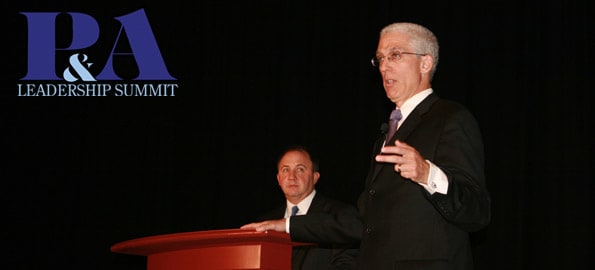
The first official P&A Leadership Summit last week at the Paris Hotel and Casino in Las Vegas kicked off with a lunch keynote from Scott Eisenberg, founder and managing partner, Amherst Partners, and the chief restructuring officer for US Fidelis during the bankruptcy proceedings; as well as Terry Keating, managing director, Amherst Partners.
US Fidelis, Eisenberg noted, at the time was the largest provider of vehicle service contracts, and employed more than 1,000 people to run the business. Darain and Cory Atkinson he noted, originally brought him in at the direction of investors - before the bankruptcy proceedings started - to try and identify what was going wrong, and fix the problem. They were hired to turn the company around, but, Eisenberg said, by the time he was brought in, it was just too late. “We quickly concluded that there was not an operation to save,” he said. “So we decided to do a wind-down of the company.”
One of the striking things he noted was that it wasn’t fraud that was the ruin of US Fidelis – every dollar, Eisenberg said, was completely accounted for in the books, with nothing hidden and every transaction transparent. The problem, at heart, was one of mismanagement. The Atkinsons were using the incoming funds from new contracts to pay out current claims, and instead of setting aside a reserve fund, they were taking the excess out as profit. According to Eisenberg, there was about $101 million in funds taken out by the two brothers in total. They were, essentially, running the company on a cash basis.
That’s not to say that poor business decisions alone were the issue. Eisenberg noted a few additional problems that contributed to the downfall – refunds were not paid in a timely manner (or at all), they used high-pressure sales tactics and they violated Do Not Call regulations, all of which led to high rates of cancellations and unhappy consumers. On top of that, the economy crashed, so, with escalating cancellations and the need to rely on incoming cash to pay outgoing claims, the system quickly became unsustainable.
“The industry was not the problem,” said Keating. “They had a flawed business plan and careless execution.” He went on to note that it was “like the Wild West,” with no good policies in place, no regulations about how to handle claims and customers, and no internal controls or oversight. The company was open and transparent about everything it did, but the company was operating with very little real structure. “No one there asked the right questions,” Keating said. “The blame falls all around.”
In the end, Eisenberg noted, the company was liquidated. They had to cease industry involvement, all of their employees lost their jobs with no severance or benefits, and the Atkinsons had to forfeit almost all of their assets back to the company, to be used to pay off creditors, including a class action of customers looking for refunds. That class did not include all customers – even in the midst of the proceedings, all contracts continued to be honored until they expired – consumers could still make claims against their paid contract, and receive the benefits they were entitled to. However, by 2009, Eisenberg estimates that as many as 80% of contracts were being cancelled.
Each brother was allowed to keep $500,000 and one of them was allowed to retain an educational trust he had set up for his children. Other than that, they lost everything – at the end of the day, Keating estimates that about $200 million was recovered from the joint Atkinson assets, including properties sold around the world, all be it at a discount – for example, a $30 million house (palace would be a better description) sold for just $4.7 million. But creditors and providers lost out as well. Keating noted that media and vendors in the end had to walk away from huge amounts owed because there was simply nothing left with which to pay them.
“At the end of the day, it was a very painful thing,” said Eisenberg.
The hardest part, said both Keating and Eisenberg, was that the brothers were both nice, personable men. However, both of them did have prior felony convictions, which Keating said should have raised red flags with investors – the information, he noted, is available via a quick Google search, so it wasn’t being concealed. “No one advised them not to do this,” said Keating. “No attorneys, no one told them they needed reserves. And if they had taken $20 million out rather than $101 million over the five years, the company would have been fine.” The brothers were eventually both convicted on charges of consumer fraud and violations of consumer protection rules, and were sentenced to prison time.
In the end, by the time Amherst Partners came in, the issues were insurmountable. Which is a shame, Keating said, because the day-to-day people were very good at their jobs. “There was great reporting, and they were very good. It was clearly an issue confined to the upper level.” They were playing by the rules at that point, “but the sins of the past were just too much to overcome.”