Success in the F&I office is a win-win situation. Every product attached to the deal means added revenue for dealers and greater peace of mind for car buyers. But it’s no easy task. It takes training, experience and a growing reliance on smart technology.
F&I products are, by nature, complex. As a result, they need to be backed by complex and continually evolving software. The architecture is largely invisible to dealers, but they depend on it for every transaction.
Ron Greer, vice president of provider services for the Provider Exchange Network (PEN), compares the software to electrical wiring. “Nobody cares who made it unless it doesn’t work.”
Making Connections
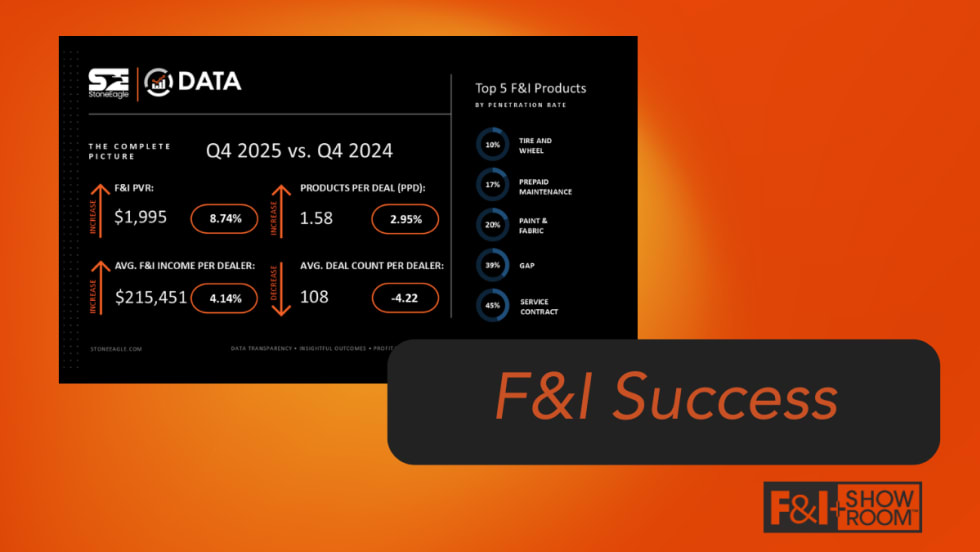
F&I Administration Solutions LLC and the StoneEagle Group both offer administration platforms for F&I products on the software as a service (SaaS) model. PEN, a division of Open Dealer Exchange (ODE), also is in the SaaS business, and Greer's goal is to connect product providers to dealers across North America. All three companies are dedicated to the development of their solutions and, as is the nature of the SaaS model, are able to distribute their costs — and savings — across their respective client bases.
But some providers have elected to keep the administration of their products in-house. They choose that course by weighing several factors, including the desire for control, flexibility and speed-to-market.
“You have total control. You set the priorities,” says Kelly Price, president of National Automotive Experts (NAE). Price says her company last considered using a large-scale SaaS provider in 2005. She was told it would take six months to add additional products. "The timeline to get something programmed would be too long for our company to bear."
Her sentiments are echoed by Matt Nowicki, vice president of retail software for Innovative Aftermarket Systems (IAS) and chief architect of that company’s back-end administrative system. He says he has recommended SaaS for smaller third-party administrators (TPAs), but it wouldn’t work for IAS.
“The dividing line is related to the number of product lines and variables,” Nowicki says, noting that IAS’s suite of offerings requires hundreds of unique forms. And when new opportunities present themselves in the form of a new or modified product, he wants to be able to deliver it quickly.
Quantities of Scale
F&I Admin’s COO, Kumar Kathinokkula, says that those very arguments to keep software in-house are often the most compelling reasons for signing onto the SaaS model. To remain competitive, a SaaS provider needs to be flexible, fast to move products to market and, most importantly, put control in the hands of the providers.
“The SaaS model makes obvious sense to the small to mid-size third-party administrators,” Kathinokkula says. “The larger TPAs have more financial resources to support the required IT department to deliver on their requirements; although, of late, we have been approached by many larger providers as they struggle to keep up with the demands of their product and sales teams.”
Kathinokkula believes that an industry populated by increasing numbers of products and variations on those products will require increasingly powerful technology. “For administrators, sometimes the price is just too high.”
Andy Hamilton, vice president of StoneEagle Insurance Systems for the StoneEagle Group, agrees. He says his company provides a platform designed to accommodate new providers as well as companies that have built administrative systems of their own. In his experience, growing TPAs tend to reach a tipping point at which SaaS becomes the only sensible choice.
“Some small TPAs say, ‘We want to control it, no matter the scale,’” Hamilton says. “But the costs [to build] are astronomically high.”
Buying Brainpower
At IAS, Nowicki reports that his IT staff includes 14 people with an average tenure of about eight years. NAE’s Price says she has been fortunate in the personnel department as well: “We’ve had the same programmer since 1996, and we’ve brought on two more in the last few years, and they’ve stayed.”
But Kathinokkula believes that technology departments must make sure they do not get left behind by the latest development tools and database capabilities. “For dependable, reliable software, [you must] hire experts with intimate knowledge in the latest technologies,” he says.
Price and Nowicki would argue that their internal IT departments have met that challenge and maintained the level of control they desire. Greer, Hamilton, Kathinokkula and other proponents of SaaS believe their companies’ scale offers the same level of control, but with many additional advantages, including the ability to keep up with new products and other continuing demands from provider sales and product departments.
Ultimately, TPAs that partner with SaaS providers and those that build their own platforms share a common goal: Create a system that allows product providers to focus on developing, marketing and branding their offerings. Let dealers focus on sales, and let their customers enjoy the benefits of a secured purchase.
Where do you stand on this issue? Write in to let us know where you stand on the continuing debate over SaaS versus build.