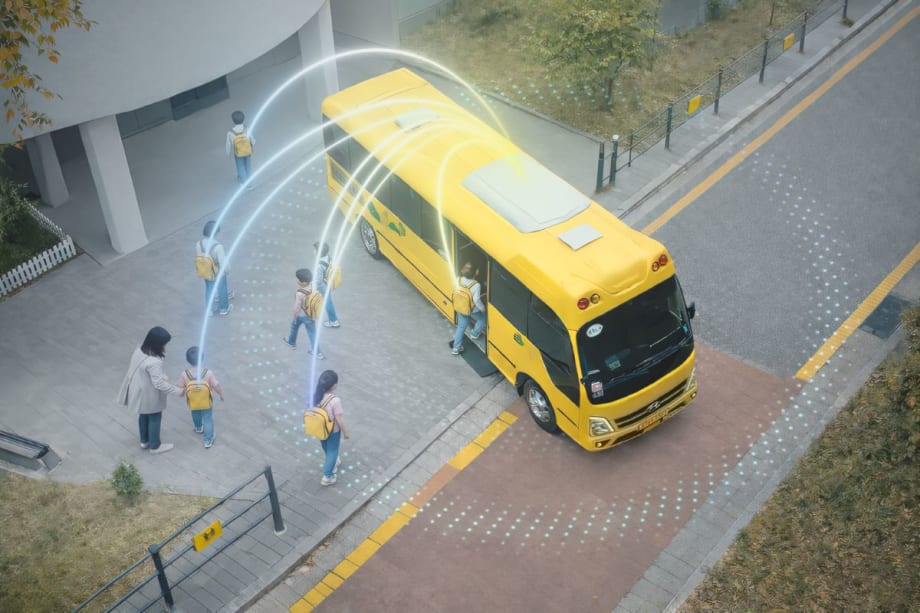
Hyundai and Kia announced a new driver-safety technology, Vision Pulse, that can detect precise object positions in real time.
Vision Pulse uses ultra-wide band, or UWB, modules that communicate via radio waves from other UWB modules. The system measures the time it takes for those radio waves or signals to travel between the modules and uses that time to calculate their exact positions. It then issues an alert when a potential collision is detected.
According to Hyundai, the system has a 10-centimeter margin of error across a 100-meter radius, even in complex urban intersections. And it maintains over 99% detection accuracy in adverse weather or nighttime conditions with communication speeds of one to five milliseconds.
Vehicles equipped with Hyundai and Kia’s Digital Key 2 already include UWB modules, but the technology can be integrated into other vehicles through additional UWB modules. The digital key feature allows people to access and drive their vehicles via compatible mobile devices.
The automakers said they anticipate extending the technology beyond driver assistance to include industrial mobility and disaster-response applications. Trials have already started at the Kia PBV Conversion Center in Hwaseong, South Korea, to help prevent collisions between forklifts and workers. And trials are set to begin at the Busan Port Authority to assess capabilities between workers and mobile machinery.