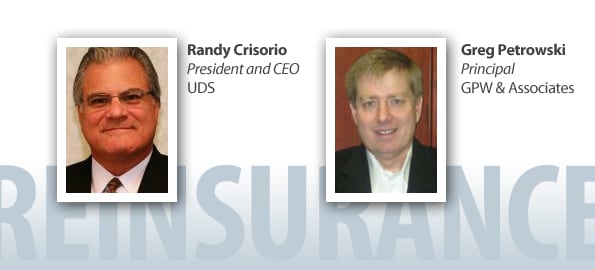
On Tuesday, March 13, at Agent Summit 2012, two veterans of the reinsurance segment teamed up to give agents a crash course on the subject. “Reinsurance: Painting the Right Picture for Your Dealers” was led by Randy Crisorio, president and CEO of Clearwater, Fla.-based United Development Systems Inc. and Greg Petrowski, principal of GPW & Associates Inc. in Phoenix.
Crisorio opened the session by noting that he and Petrowski had prepared by creating a list of questions agents might ask about reinsurance, noting that the crowd would include a “great disparity” in expertise and experience level.
“I know when I started out in this field, reinsurance was a great mystery,” Crisorio said. “Once you get to know it and love it for its benefits, good things happen.”
Crisorio: How many forms of reinsurance are available today?
Petrowski: Well, right now, there’s the typical CFC structure, or the dealer- or agent-owned reinsurance company. There’s also a multiple stock-class structure, which is similar to a group captive, where you may have a non-controlled foreign corporation or “NCFC,” with many unrelated dealers.
There’s also another program out there today that’s kind of similar to reinsurance — it isn’t reinsurance — and that would be a dealer-owned company, where the dealer actually owns an administered warranty company and writes their own product and has a stake in that company.
So there are three forms right now, and some hybrids of those as well.
So the dealer-owned insurance company isn’t really an insurance operation?
Correct. It’s an administrator-obligor company. It typically carries on insurance while there’s a failure-to-perform or excess-of-loss policy on the back end, in the event their administrator-obligor company goes under.
Is one form better than another, in your mind?
I think all forms have their place, and they all offer a unique and beneficial solution to dealers and agents.
Well, if we look at the motivation for the dealer body, we could think about the folks just entering the business who would offer, say, a service contract product. [They know] that the providers have a certain level of income they rely on and that’s why they’re in that business. So the selling condition goes to the dealer, the provider’s making some money, and [the dealer] gets whatever remnants of service profitability from that sale, through their service operation.
The next step is retrospective commissions, where they’re getting some experience rating unlimited investment income but they have not yet advanced to the reinsurance level, where they’re exchanging some risk for some premium. And that’s really pretty much the basis for reinsurance, yes?
Correct. The nice thing with starting a reinsurance program at the service contract level is that it also gives the dealer or the agent an opportunity to look at [additional] products. So you may start with service contracts, where you have the opportunity to share in the back-end profits, and expand into those other products which might not offer those same avenues without a reinsurance platform [already in place].
Greg, how long have these platforms been available for F&I protection products?
I’ve been doing this now for about 25 years. When I first started, it was credit insurance. And a lot of you out there who are as old as I am or older will remember that credit insurance products really started in the F&I area. We’ve got a handful of clients that actually date back to the mid-’60s. So dealer reinsurance has been around for quite some time.
You’re thinking back to a time in the credit insurance arena when reinsurance was popular in the state of Arizona, and that takes us well back. Would it have been possible at that time to form a company in Arizona? Do you recall?
Correct. And it was actually Texas where they first started founding mutual companies. ... Because of changes to the laws in Texas, it moved over to Arizona. And at one time — and this tends to fluctuate — it’s been anywhere from $75,000 in capital [reserve] to $150,000, and now it’s back to $75,000 for what Arizona would call an “unaffiliated credit life and disability reinsurer.” But that’s still substantially more than any investment offshore for a reinsurance program.
So I think we get the sense that, for people who are just entering our business, they hear phrases about offshore reinsurance being “voodoo.” That’s not the case. It’s a proven entity for developing profitability, and it has been for many, many years.
Next question: Are all F&I products good candidates for a reinsurance program?
The short answer is, all products have potential for underwriting profit. For a dealer or agent reinsurance company, we try to find the right mix of products that offers the best potential.
In today’s marketplace, if you look at a list of products — and I’m probably preaching to the choir here — tire and wheel is still in its relative infancy as far as pricing a product, and we’re seeing a lot of changes. You could go anywhere from a $50 premium up to more than a $1,000 premium, so we still see some volatility there.
Obviously, depending on where the dealership is located, you’re going to have more risk in the Northeast and Midwest during the winter than you would in, say, Arizona, where I live. So it may not be a product you look to for reinsurance at this point. But a few years ago, GAP was a product that was in a lot of turmoil when it came to pricing. Over the past few years, we’ve seen stabilization in the used-car market and different practices by lenders that have made GAP an attractive product to stick in a reinsurance program.
You have to look at the individual dealer. Hopefully we’ve got some loss history that we can look at to really evaluate what products make the most sense to put in the reinsurance company. Service contracts, traditionally, have been the thing to really drive the boat, so to speak. If we’ve got good experience on service contracts, we’ll look at adding the ancillary products, even those with low premium volume. For example, if you add your paint and fabric product, once you’ve got your vehicle set up, you don’t really have to be as concerned about meeting the minimum volume to keep that reinsurance program alive.
You’ve got service contracts flowing in at, let’s say, in the $300,000 to $500,000 range, we should start looking for other products to add to that reinsurance company. I think most of you are aware of what the tax regulations are now. If we’re not over $1.2 million in annual premiums, the company can elect to pay tax on that investment income only. So if you’re meeting that $300,000 to $500,000 range with service contracts only, you’ve got the opportunity as agents to offer your dealers a real positive consultation on adding some additional programs through the reinsurance program to making them more profitable.
What products are you seeing most in reinsurance at this point?
Certainly service contracts. And we’re seeing more GAP, windshield protection and appearance protection products — etch, for example. Just about any product you can sell in the F&I office.
Environmental protection as well? Key replacement?
We see a little bit of [environmental protection], yes. Key replacement is fairly new, but we’ve had a few people who have moved into reinsuring that as well.
What’s the biggest difference between a CFC and an NCFC?
The biggest difference is probably control. With a CFC, the dealer or the agent owns the reinsurance company and can take it with them if they switch providers, products, etc. An NCFC program is typically sponsored by an administrator or the insurance company and it’s basically used for [their products.] If you’re in an NCFC and you switch administrators or insurance companies, you typically don’t have the opportunity to continue to put other people’s business into that NCFC.
There are a number of tax differences. Most CFCs are set up as U.S. taxpayers and choose to pay taxes on investment income only. The NCFC programs don’t pay federal income tax. What they do pay is an excise tax, which, for the products we’re looking at here, is typically 1 percent of the premium.
Of course, today, with [the returns] we’re seeing in the investment market, as far as the returns go, most of the CFCs probably pay less tax on their investment income than an NCFC program pays on their excise tax.
That is an interesting difference. Now, onto domiciles: Where is a CFC or NCFC typically located?
There are a number of different domiciles. I think most people will tell you that for NCFCs, the Caribbean, including Bermuda, the Cayman Islands and Turks and Caicos, all are being used as domiciles and seem to be [competing] on a pretty level playing field.
On the CFC side ... the Turks and Caicos and the Seychelles are the [primary] domiciles. There are still a few stragglers in some other places. There are some dealer captive programs still out there as well, a few of them in Arizona.
Would you have any idea how many of each type are in use today?
That’s hard to estimate. ... We’ve come to the conclusion that there about 4,000 CFCs. On the NCFC side — and I’m really guessing here — somewhere in the neighborhood of 50-plus programs available today for F&I products.
So a lot of experience in this “mysterious” business.
(Laughing) Yes.
Who makes the rules and regulations that a CFC or NCFC would follow?
On the NCFC side, what we’re most concerned about are IRS regulations. You want to make sure that company does not become a U.S. taxpayer. There’s a number of regulations and requirements there. ... Obviously, with a CFC, [which is] a U.S. taxpayer, you don’t have those concerns.
So it sounds as though the IRS has written the rules and the industry has manufactured pathways to follow them.
Well, whether you’re looking at a CFC program or an NCFC program, we certainly operate to pass the test, whether that’s an IRS test or a regulatory test.
How many companies like yours, that form and manage these companies for agents and dealers, operate in this field?
As far as service providers, probably seven or eight. That’s without mentioning some of the smaller providers. And there are also a few administrators out there that provide the same services, internally, to their customers. And the top four or five companies comprise maybe 90 or 95 percent [of the market].
What does it cost to form one of these companies? Let’s start with a CFC.
Sure. You’re going to see costs ranging anywhere from $2,500 up to $5,000. The NCFC is a completely different animal. You’d probably be looking at a minimum investment of $60,000, up to maybe $100,000. ... Different programs come with different numbers. ... The other thing you’re going to have to look at is who the administrator and insurance company is. They may have different minimum volumes, and it’s going to vary by product.
Certainly, minimum volume makes sense. But there’s another piece [of the puzzle] we deal with as we go after this market, and that’s the mindset of the dealer. They’re often looking for the quick, turnkey pathway into the provider’s pocket. So perhaps they don’t think they have any responsibility. Can you talk about what makes a good dealer from your side of the business?
Well, you really can’t be an absentee-type dealer. I’ve been doing this for a long time and I’ve worked with a lot of dealers, and we’ll still run into those who will say, “I realize I’m in a CFC program, but I don’t want to do anything.” ... The best dealers to work with are those that want to become involved in the reinsurance company, want to understand what’s going on. They want to look at [the returns] on a quarterly basis. ... They want to meet with their agents and ask what they could be doing better. Those are the [dealers] who maximize the programs to their fullest potential.
How about the agent’s role in making sure this venture is a success?
You guys are all partners with your dealers. We all provide a benefit and a consultative service to the dealer. To the extent that [agents] look at this as an opportunity to go out and meet with the dealer and go over the results, I really think that it helps the relationship on so many levels.